 Posted by
Josh Richardson
Any DNA in living tissue has been proven to react to language especially when combined with specific frequencies. It is entirely normal and natural for our DNA to react to language. Limiting language has just as much an effect on our DNA has language that empowers. Listen closely to the words people use and to your own internal dialogue (that little voice in your head) and see how often you use limiting language to determine what you can and can’t do.
Affirmations, autogenous training, hypnosis and the like can have strong effects on humans, our DNA and our bodies.
When we break down what we say to ourselves into simple terms, it’s very easy to see how our thoughts and words become demotivating and limiting, not only for ourselves but also for those around us.

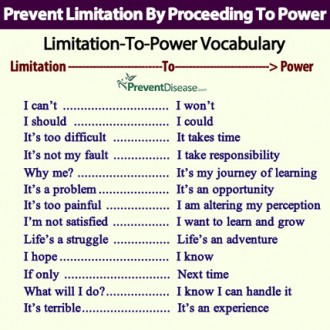
The words “I know” can be more productive and more powerful than “I hope,” but only if used in the appropriate context, for they can also be disempowering. It is very important to use “I know” in a way that allows you to expand on knowledge and not limit it. Here are a few examples of limiting words and phrases.
Think for a moment how often we hear people (or ourselves) say:
“I can’t jog for more than 5 minutes”
“I’m not good at approaching people”
“I know how to do that, you don’t need to show me”
“If I tried that, I’d certainly fail”
“I will never be able to do that”
“I’ll never lose weight”
A simple modification makes a big difference:
“I can’t jog for more than 5 minutes” becomes “I can jog for up to 5 minutes”
“I’m not good at appoaching people” becomes “I have had challenges with approaching people”
“I know how to do that, you don’t need to show me” becomes “I have some insight into the method you describe but I would love to learn more”
“If I tried that, I’d certainly fail” becomes “I have never tried it before but I’m willing to give it a go”
“I will never be able to do that” becomes “Until now I haven’t been able to achieve this”
“I’m not qualified for that job” becomes “I haven’t been able to lose weight but I certainly can try again”
Many of us are also guilty of using negative statements that limit our thinking and our potential. There are even ways to use seemingly positive statements in self-limiting ways, such “a once-in-a-lifetime opportunity.” Really? Opportunities are only once in a lifetime if you want them to be.
One of the the biggest blocks in the mind of a beginner mind is knowing it all, and it’s for this reason that the 2 of the most limiting words in the English language are “I know.” The problem with “I know” is that once those words are out of your mouth it’s highly likely that you have stopped fully listening and are are restricting the amount of information that you take in.
“If you have to tell people you know, you don’t know. People that know don’t tend to tell people they know since additional insight can come from anywhere.” Tony Robbins
We use language and our communication to shift our own way of being in the world; to motivate and understand ourselves. Psychologist Martin Seligman’s work with “Learned Optimism” at Penn State relies heavily on our internal communication. Our psychology (our mind and behavior) is fluid and changeable. Just as our perspectives affect our language, our language can have a remarkable impact on our outlook.
“Everybody always does this to me” becomes a recipe for depression, whereas addressing the pervasiveness, [everybody] the permanence, [always] and the personalization, [to me] could completely reverse the affect a circumstance would have on you. Communication gives us a way in to our own insides, and a way in to others. As long as we’re going there, it couldn’t hurt to do it consciously. Doing so gives us far more options and choices. You might even say it gives us optimized results. When we expand our limits and then finally go beyond them, we find our power and ability to achieve is limitless.
This article, which originally appeared here, is offered under Creative Commons license.
Josh Richardson is blogger, healer, and a constant pursuer of the natural state of human consciousness.