 Posted by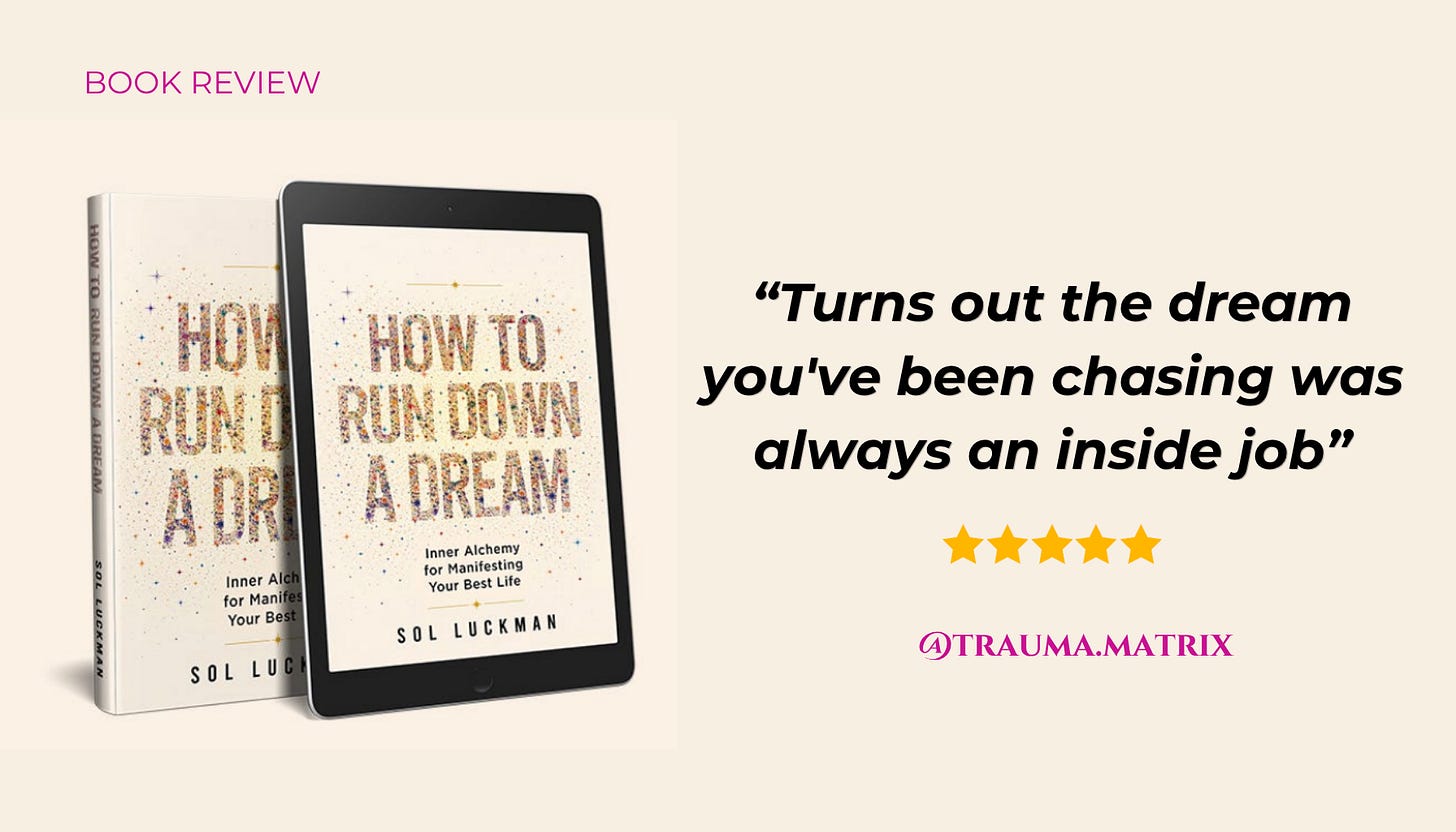
Emma Lyons (Guest)
Sol Luckman’s latest book, HOW TO RUN DOWN A DREAM, goes far beyond the usual trends of manifesting external material desires. Instead, the book runs down a very different dream: the potential that resides inside each of us to fully connect with and embody our true, authentic sovereignty.
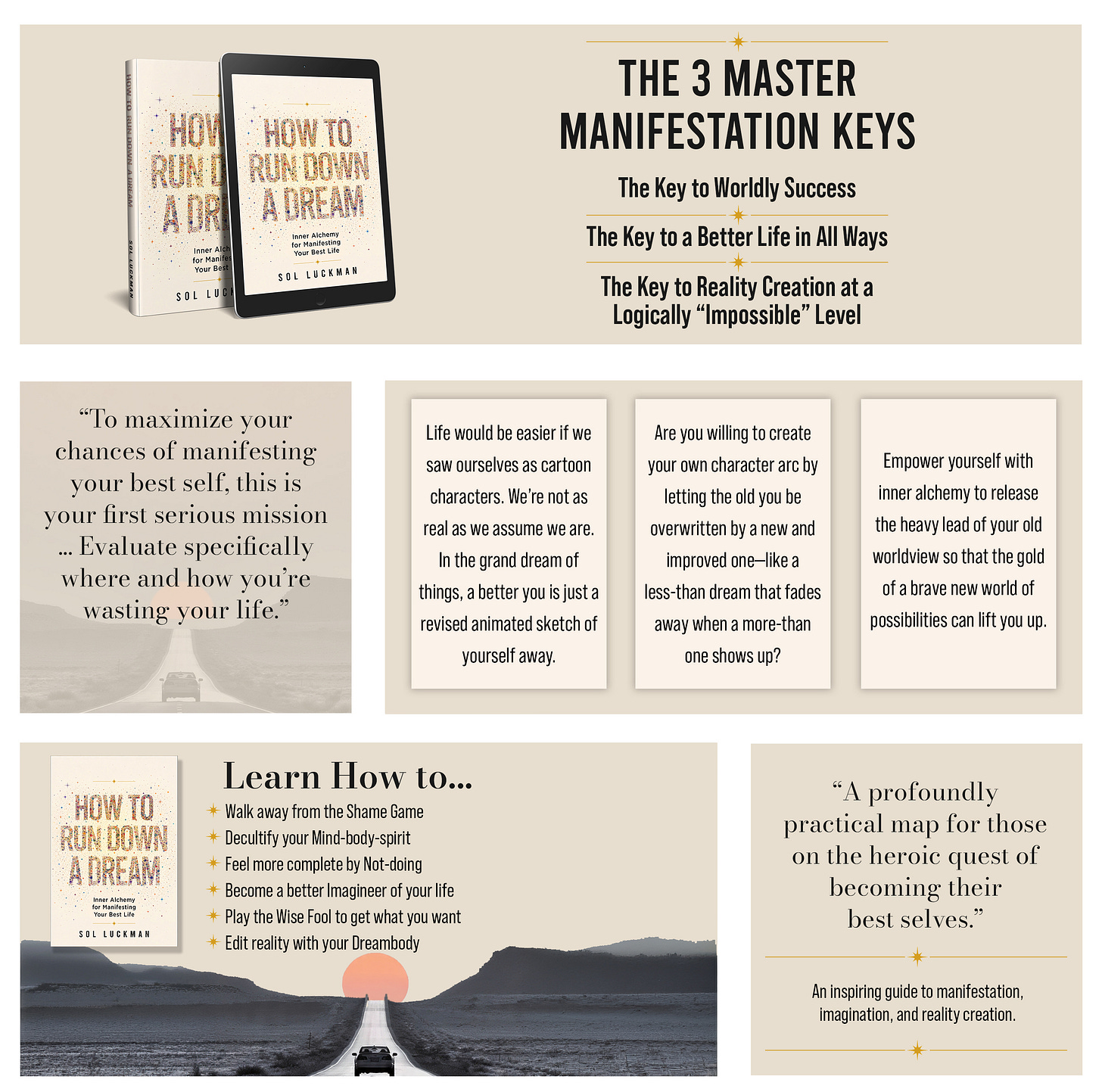
Sol opens by unsettling the reader with something most of us never stop to question—that the past is fixed, that memory is reliable, and that reality is solid under our feet. Referencing the Mandela Effect, the unsettling phenomenon whereby entire groups of people share in the same ‘incorrect’ memory of events in the past, he shows that even our most basic assumptions about agreed-upon reality don’t actually hold up under scrutiny. And if something as fundamental as collective memory can bend, what else that we’ve been told is fixed might actually be malleable? Once the reader is disarmed to perceive reality itself as less solid than previously thought, the question shifts from ‘how do I manifest the stuff I want in my life’ to what have I been brainwashed to believing is impossible for my life that is in realisable once you fully own your power within the malleable matrix of the world.
Sol traces the origin of this lock on our potential back to Genesis and the Garden of Eden, the moment humanity moved from embodied, unselfconscious presence and oneness into a permanent state of self-surveillance laced with shame. The books shows that the Genesis story itself draws on even older Mesopotamian traditions, suggesting an even deeper foundation in human history. What I find most compelling in Sol’s reading of this is the claim that this shift was less a moral evolution, and rather a breach—the installation of an internal surveillance system where none had existed before.
The Loosh Engine & The Dragon’s OS
From there, Sol builds out the systems of control that capitalise on that original breach—the Loosh Engine, a system that harvests emotional charge from human conflict, fear, and unworthiness, and the Dragon’s OS—the operating system that keeps the collective locked in perpetual low-grade crisis.
While the terminology I use differs from Sol’s, our foundations remain consistent. Sol calls this structure that forces the vast majority of people on the planet to live in a perpetual state of drama, the Dragon’s OS. In my work I call this the Shame Operating system—the mechanism which perpetually keeps humans cycling through what Karpman called The Drama Triangle (Persecutor, Victim, Rescuer) all three roles fueled by shame.
Sol arrives at the same idea as I do, that shame fuels a huge amount of this loosh; pointing to my work, particularly the B.R.E.A.K. pattern interrupt as a practical somatic framework designed to interrupt the power of that internal shame voice the moment it strikes.
The Scapegoat’s Realization
I created the B.R.E.A.K. protocol for myself after years of struggling with persistent depression, compulsive self-shaming, including frequent moments where staying alive felt futile.
After a traumatic injury forced me to recognise narcissistic patterns in my family of origin, I discovered that I had spent my entire life playing the scapegoat role, carrying the heavy load of shame and unresolved intergenerational trauma for family system.
All my life till that point, I had thought I was the problem. I had tried every form of healing and therapy. Sometimes it made life survivable, but the underlying loop remained and always seemed to return. Whenever I found something I was deeply passionate about, when I got excited about becoming a singer, a yoga teacher, whatever -my mother would pour cold water it. In hour long lectures she would tell me that what I wanted was impossible, demanding that I “be realistic” and do something she considered to be “for my best”.
As I unpacked the narcissistic dynamics of my family, I realised that what I had thought was “concern and care” for my well-being, was not true concern at all. Instead, it was a form of shaming designed to create compliance, keep me small and safeguard my mother’s anxiety.
The Antithesis of Love
This insight exposed the true nature of the “inner critic”, that internal voice we are constantly told to soothe, love, and negotiate with. The entire world of therapy and self-help will tell you that the shame voice is “ just trying to keep you safe.” But as I came to witness how the inner critic mirrored almost perfectly the exact same shaming strategies and words used by family, I came alive to the fact that the voice, which at its most malignant would encourage a self-destructive exit from the pain cycle, was not a friend, or protector at all.
Shame is lauded in our society as a tool of love and morality, but through my own process I came to see that, beneath the surface, shame is the ultimate trance we have all been under since the forked tongued serpent convinced Eve that it would help us grow and expand. The truth, I found is quite the opposite: shame, unlike anger ( useful to set boundaries) and fear (essential when a genuine threat exists) serves no positive purpose other than to shrink and control the individual. It creates compliance yes, but is never truly a force for truth and empowerment. Look closely and you’ll also see that shame consistently prioritises the comfort of the shamer above all else, even when it masquerades as concern and education for the person on the receiving end.
As Sol states in the book Shame is the true opposite of love. It is never really about moral correction. Instead it’s a dirty short-cut that looks impressive because it works fast to induce compliance. While guilt—the belief—“I’ve done something bad” can be useful, shame the belief that “I’m bad or defective” serves no positive function, and actually neurologically inhibits empathy and accountability. The only true function of shame therefore is to maintain order in hierarchies, to police your sovereignty in order to stabilise someone else’s unexamined defectiveness or delusion of superiority. This is something that I’m no longer willing to do, and the more shame I extricate from my system, my nervous system no longer tolerates it. I no longer need a 5 point plan to set a boundary, as my nervous system just says hell no when abusive situations arise, or when someone uses shaming strategies to coerce me to do what makes them feel comfortable.
The Radical Break from Therapy Orthodoxy
This realisation forced a radical break from traditional IFS and healing orthodoxy: the shame voice is not a “miscalibrated protector” to be loved back into kindness.
It is not an expression of love. It carries the exact imprint of external narcissism, except the call is coming from inside the house. It is an internalised construct that does not exist to protect you, but to protect its own access to your energy.
Both the inner and outer narcissist gain their power (supply) by keeping us performing, defending, justifying, and reacting, thereby ensuring its dominion continues.
All my life, I had followed the guidance to love this voice more. I listened to its criticisms, took them to heart, and tried to placate and reason with it. But when dealing with a narcissist outside, negotiation is a trap. The only way to stop a narcissist, whether internal or external, is to cut off its supply. When I put this into practice with my own inner narcissist, I created the BREAK pattern interrupt (a 90 second pattern break that with practice breaks the spell the shame voice holds) and I was able to take back the power it had been siphening from me my entire life.
The Hero’s Journey & The Chamber
Sol outlines the BREAK pattern interrupt in chapter 3, so readers can immediately start severing the shame loop, and cut off the extraction of loosh in their own inner world. Beyond that, Sol guides the reader through the hero’s journey of building a sovereign life: energizing the dream body, moving past the interference of the Dragon, and building an inner chamber to shape your ideal reality.
It is a living manual for unlearning social conditioning and stepping completely off the harvest grid. This is not a book that I will read only once and shelve. I’ll have it on my nightstand and know I’ll keep coming back to it to work with the practical exercises, to visualise and ultimately create my most empowered body and life.

Highly recommended.
👉 👉 👉 If this review has you curious, you can pick up an advance review copy or preorder “How to Run Down a Dream” here.